

The short version:
-
Every renewal, group benefits pricing resets to the same starting line: the same raters rebuilt, the same negotiations re-run. It feels like fate. It's a flywheel that's been turning the wrong way.
-
The friction points that recur every cycle are also the opportunities that recur every cycle. Govern the rating logic once and next year's pricing starts where this year's ended, instead of starting over.
-
Because the cycle is annual, the gains stack: legibility, reuse, accuracy, and capacity build on each other year over year. Faster quotes follow from that, rather than leading it.
-
None of this takes a rebuild. The logic stays in the Excel your actuaries trust. What changes is whether last year's work carries forward.
Every renewal season, group benefits pricing can leave actuaries and underwriters feeling a little like Bill Murray in Groundhog Day: the same Excel models reworked, the same negotiations re-run, the same manual steps that never quite end. For most pricing teams this isn't a complaint about the work. It's how the work has always been done.
A loop that repeats on a fixed schedule is the easiest kind of process to improve, because every fix you make lands again next year, and the year after. The recurrence that makes the grind feel inevitable is the same recurrence that makes it compound once you change it.
Group benefits pricing repeats this way for one reason: the rating logic behind it is ungoverned. Rate manuals, experience-rating workbooks, and eligibility rules live across dozens of spreadsheet versions with no single source the business can build on, so every renewal resets to the same starting line. Nothing from last year was governed enough to carry forward. Govern that logic and the same loop starts working in your favor.
Where does the pricing cycle reset every year?
The cycle resets at every point where the work depends on manual effort against an ungoverned rater. Three stages absorb most of it: initial rating, re-rating through negotiation, and the final round of enrollment adjustments.
Follow a single group case through a renewal and the resets show up in the same places every time. Census files arrive through brokers in mismatched formats, and the cleanup starts before anyone has rated a thing. That is friction, but it isn't where the loop bites hardest. The reset bites where the logic lives.
Initial rating
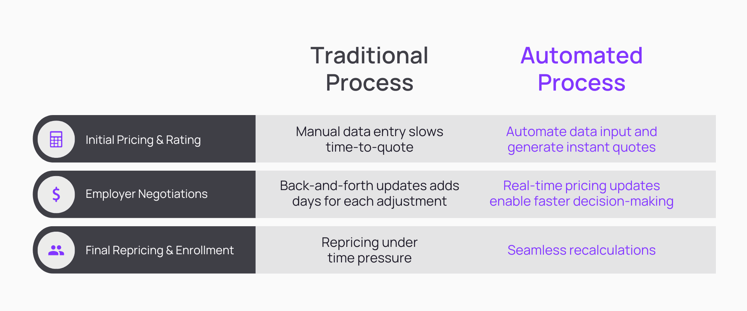
Today, actuaries move census data into their trusted Excel raters and rebuild the quote by hand, against the same models as last year, as if last year never happened. The intellectual property in those raters is real and built over years; the re-keying around them is pure repetition.
Govern the logic and the rating runs against one governed rater, so this cycle starts from last year's version rather than a blank rebuild. The work your team did last renewal becomes the foundation for this one.
Re-rating through negotiation
Today, every employer adjustment triggers another manual round: calculations re-run, spreadsheets updated, documents regenerated, sometimes for weeks.
Improve the governance layer, and an adjustment is a parameter change rather than a rebuild. The version that priced this case is kept, versioned and testable, so the next renewal opens from a known-good base instead of a folder full of last year's files.
Enrollment adjustments
Today, actual enrollment rarely matches projections, which forces one more manual round under time pressure after the case already looked closed.
With version control in place, the recalculation runs against the same rater that priced the case, and the reconciled result becomes part of next year's starting point instead of a scramble forgotten by the next cycle.
All three stages share the same shape. Today each stage starts from zero, and the work disappears the moment the cycle ends. Govern the logic and each stage starts from where it finished last time.
Why can't Excel alone fix the group benefits pricing loop?
Excel can't close the loop on its own because it was built for modeling, not for version control, governed reuse, or an audit trail you can reconstruct for a rate filing.
That isn't a knock on the tool. Excel is the workhorse of group benefits pricing for good reason: it's powerful, everyone knows it, and the intellectual property inside those raters is real and built over years. The gap is narrow and specific, and it's where the loop comes from.
And discipline alone doesn't close it. You can name your files carefully, lock your tabs, and keep a master copy, and the wrong version still reaches a quote — because version control and an audit trail aren't a feature you're missing in Excel. They're a layer that has to sit around it. That layer is what stops the "which version is real" scramble from restarting the cycle every year.
The loop that compounds
A one-time efficiency saves you once. A loop that compounds saves you every cycle, and the gains stack on each other. The estate gets more legible, the logic gets more reusable, rate changes get more accurate because they're tested against a known base, and capacity rises because no one is rebuilding from scratch. Faster quotes are part of that payoff, and they come from governing the logic first. And next year's pricing inherits this year's work instead of repeating it.
The same cadence can run against you just as easily. Leave the logic ungoverned and every renewal adds more raters and more versions to account for, so the silent cost of the loop compounds quietly in the other direction. The recurrence isn't inherently a tax. Governed, it pays back.
None of this requires ripping out Excel.
Here's how Coherent accelerates group benefits pricing without trading away control:
-
The logic stays yours. Coherent runs the rating logic inside your existing Excel models, so actuaries and underwriters keep the tools they trust while the re-keying disappears.
-
One number, everywhere it's quoted. Your governed rating logic runs in the pricing and sales systems where deals happen, including Salesforce, so a parameter change updates the quote in real time instead of through copy-paste.
-
Scale past case-by-case. A slow, manual process becomes a repeatable one, so you carry more volume without adding headcount.
-
A living rater, not an annual file drop. Instead of redistributing updated Excel files every renewal, you adjust parameters once, with every change versioned and tested, so accuracy compounds year over year instead of drifting.
With governance and speed arriving together, the quote moves at the speed of the negotiation while staying versioned and audit-logged underneath. A faster quote is now also one you can prove.
Carriers are already turning the loop this way with Coherent. One top-three carrier in group dental, life, and disability did it without the rebuild it had been quoted, governing its rating logic in place and saving roughly $750K in developer cost per rater, while keeping its actuaries in the Excel they already knew.
Escape the cycle for good
The loop will run again next renewal regardless. The only real question is whether it resets to zero or starts from where you left off. For most carriers it still resets, and that cost compounds quietly every cycle, which is the thing worth putting a number on next.
The smaller first step is to look at your own rater estate and find the stages where the reset bites hardest. That's where the flywheel is easiest to start turning, and where one governed cycle begins paying back the next.