
Last Updated February 12, 2026

Underwriting teams struggle with speed and consistency when raters are treated like static Excel files instead of managed systems. Modern rater management applies governance, approvals, and version control around spreadsheet-based rating logic, so underwriters can quote faster, trust the numbers, and deploy changes without waiting on IT.
Why Rater Management Matters Right Now
Excel still powers most insurance raters. That hasn’t changed.
What has changed is the scale and complexity of underwriting workflows:
-
More products and specialty lines
-
More state- and broker-specific variations
-
More exceptions, referrals, and overrides
-
Higher expectations for auditability and consistency
When raters were small and teams were tight-knit, informal processes worked. Email approvals, shared folders, naming conventions like "Final_v3_ACTUAL.xlsx" were good enough.
They aren't anymore.
As underwriting organizations scale, rating logic starts behaving like infrastructure. And yet it’s still being managed like a file. That mismatch is where speed breaks down, where audit deficiencies surface, and where institutional knowledge quietly bleeds out as teams churn.
Where Traditional Rater Workflows Fail
Most rater issues don’t come from bad models. They come from how those models move through the organization.
Common failure points:
-
Version sprawl: Multiple copies of the same rater circulate with no clear source of truth. Is it the version in your inbox? The one on SharePoint? The one your colleague sent last week?
-
Approval ambiguity: Underwriters aren't sure which changes are approved and which aren't. So they either wait for confirmation or move forward and hope.
-
Manual rework: The same spreadsheet gets rerun repeatedly for small variations. Change one variable, recalculate everything, export, repeat. When outputs still need to be copied into downstream systems by hand, the defect rate climbs with every step.
-
Audit blind spots: When regulators ask which rater version produced a specific quote six months ago, the answer is often "we think it was this one." For organizations already navigating EUC and model risk scrutiny, that's not a comfortable position.
None of this is caused by Excel itself. It’s caused by the lack of a system around Excel.
This is the gap rater management is designed to close.
What Rater Management Actually Is (and Isn’t)
Rater management is often misunderstood, so it’s worth being precise.
Rater management is not:
-
Rebuilding raters in a new rating engine
-
Replacing Excel with a custom underwriting workbench
-
Adding heavy governance that slows teams down
Rater management is:
-
Treating rating logic as a governed asset
-
Applying approvals, versioning, and auditability to how raters are used
-
Keeping Excel as the modeling interface while controlling execution
In other words, rater management separates how logic is built from how it’s operated.
That distinction matters, especially when you compare it to the alternatives.
Traditional rating engines require full rebuilds and take months or years to deliver value. EUC governance tools address compliance but don't improve underwriting speed. Pricing platforms solve a different problem entirely. Rater management sits in the gap between all three: immediate governance with a clear path toward broader automation.
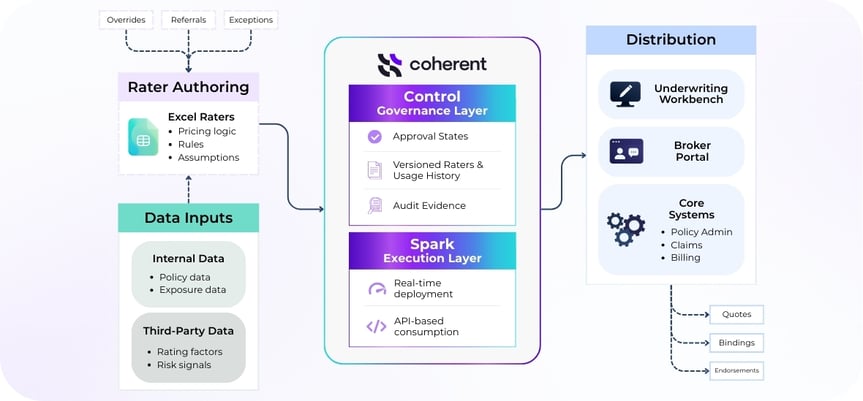
One governed rater, executed everywhere:
Approvals, versioning, and execution work together to eliminate drift without slowing underwriting teams.
What Changes When Raters Are Managed
When insurers implement rater management, the impact shows up immediately in underwriting workflows.
Faster, safer approvals
Approval cycles shrink because approvals are embedded in the workflow, not handled via email. Maker-checker processes, referral workflows, and SLA timers replace informal sign-offs. Underwriters know instantly whether a rater version is approved for use.
Coherent Control enables this by embedding role-based approvals, versioning, and audit trails directly into spreadsheet-driven processes, without changing how underwriters work day to day.
Consistent quotes across teams and channels
When there is a single governed version of a rater, quotes stop drifting. Brokers get consistent answers. Managers stop reconciling discrepancies after the fact.
With Coherent Spark, approved rater logic can be executed consistently wherever quotes are generated, whether that’s an underwriting workbench, a broker portal, or a downstream system. APIs and webhooks push outputs into data warehouses, BI platforms, and policy administration systems automatically.
Less manual re-keying
Underwriters spend less time rerunning spreadsheets or re-entering data for small variations. Inputs, outputs, and decisions are captured automatically as part of the workflow. Control’s structured data capture and Spark’s execution layer reinforce each other: governance without extra admin work.
Confidence instead of hesitation
The biggest shift may be psychological. Underwriters stop second-guessing whether they’re using the “right” rater. They can focus on risk judgment instead of process mechanics. And that confidence is what unlocks speed.
The Hidden Value: Rater Data as a Strategic Asset
Beyond operational improvements, rater management creates something most insurers don't have today: clean, structured data from every rater run.
Every time a governed rater executes, it generates a log. Aggregate those logs and you have a dataset that powers analysis most teams currently do manually, or not at all.
-
Rate change analysis across periods: Track pricing deltas over time, understand what's driving rate adjustments, and forecast revenue implications with real data instead of estimates.
-
Portfolio profitability by segment: Use enriched rater run logs to analyze profitability across products, geographies, and customer segments. Identify where you're growing and where margins are thinning.
-
Anomaly detection across your rater portfolio: Dashboards showing utilization patterns, hit ratios, and pricing outliers help pricing and actuarial leaders spot problems before they compound.
This is where rater management stops being a governance project and starts becoming a data strategy. The run logs feed directly into data warehouses and BI tools, creating a single source of truth for all rating-related insight.
For Chief Actuaries and Pricing Heads in particular, this is often the part of the story that changes the conversation from "nice to have" to "we need this."
How Insurers Implement Rater Management in Practice
Most insurers don't start with a full rollout. They start with two or three raters, usually the ones causing the most friction.
A typical approach within the Coherent platform:
-
First, discovery: analyze existing Excel-based raters, identify dependencies, and define requirements for migration and governance.
-
Then configuration: set up access controls, workflow rules, and integration points.
-
Next, migration and testing: upload and validate existing Excel raters through user acceptance testing.
-
Finally, deployment and training for actuarial, underwriting, and IT teams.
Because existing Excel logic is reused, not rebuilt, improvements are measured in weeks rather than months. Teams see faster approvals and clearer audit evidence almost immediately.
From there, rater management expands line by line, team by team.
The Bigger Shift: From Files to Systems
At a strategic level, rater management reflects a broader change in underwriting operations.
Insurers are realizing that:
-
Rating logic is a core system, even if it lives in Excel
-
Speed and governance don’t have to be tradeoffs
-
Execution friction is a competitive disadvantage
Coherent’s platform exists to support this shift—making underwriting logic observable, governed, and executable without forcing teams to abandon the tools they trust.
Raters don’t disappear. They become infrastructure.