Why Forward-Looking Insurers Are Rethinking Commission Management
Last Updated July 7, 2026
Commission programs have always determined how producers are paid. Increasingly, they're also determining how insurers grow.
When insurance executives discuss growth strategies, the conversation usually revolves around products, pricing, underwriting, or distribution. New products are launched to meet emerging market needs. Pricing models evolve to remain competitive. Underwriting guidelines are refined to balance growth and profitability. Distribution strategies adapt as carriers strengthen relationships with agents, brokers, MGAs, and new digital channels.
Yet there is another lever that influences nearly every one of these initiatives, even though it often receives far less strategic attention.
Commission management.
For decades, commission systems have been viewed primarily as operational infrastructure. Their purpose has been clear: calculate commissions accurately, ensure producers are paid correctly, and support the financial processes that keep an organization running. Accuracy, compliance, and reliability have naturally been the measures of success.
Those responsibilities remain critically important.
But forward-looking insurers are beginning to recognize that commission management can contribute to something much larger than operational efficiency. When commission strategies evolve alongside business priorities, they become an active part of how insurers encourage profitable growth, strengthen producer relationships, and respond to changing market opportunities.
That represents an important shift in perspective. Rather than asking how quickly commissions can be calculated, organizations are beginning to ask how commission strategies can help shape business outcomes.
Commission Programs Are About More Than Compensation
Every insurer has a vision for the business it wants to write.
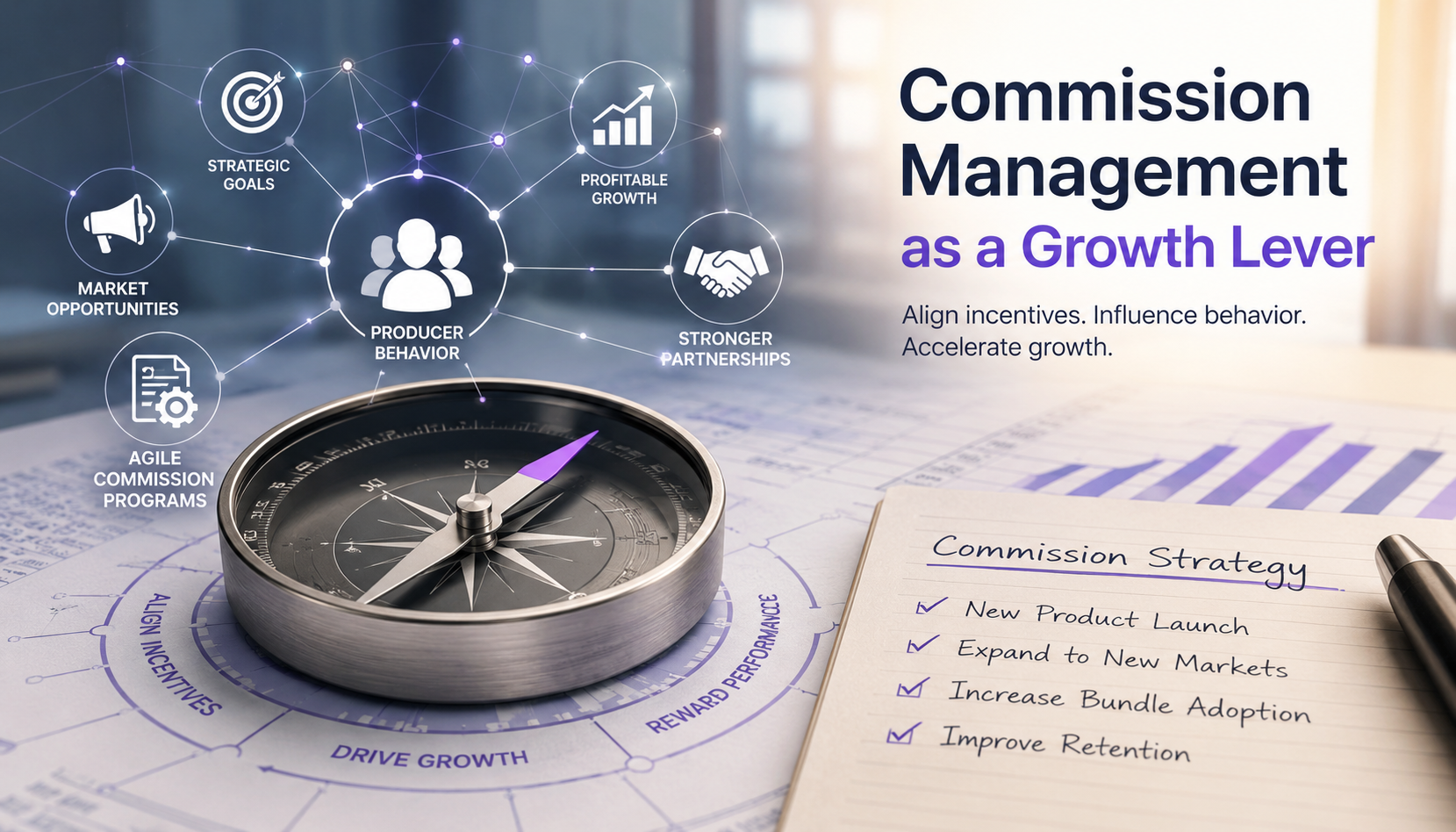
One organization may be preparing to launch a new specialty product. Another may be expanding into additional states or territories. A carrier may decide that increasing policy bundles is a strategic priority because customers with multiple products tend to stay longer and generate greater lifetime value. Others may want to encourage producers to focus on commercial business, improve renewal retention, or grow in segments that have historically delivered stronger underwriting performance.
These priorities don't exist in isolation. They are typically supported by marketing campaigns, sales initiatives, underwriting appetite changes, and executive sponsorship.
Commission strategy deserves a place in that conversation as well.
Independent agents and brokers make placement decisions every day based on a combination of factors. They consider product competitiveness, underwriting expertise, service quality, relationships, claims experience, and the needs of their clients. Commission structures also play an important role by reinforcing where an insurer wants to focus its attention.
Imagine a carrier introducing a temporary incentive for bundled commercial policies during a product launch. Or offering an additional commission for producers writing business in a newly expanded territory. Perhaps leadership wants to encourage existing agencies to cross-sell umbrella coverage or reward producers who consistently retain profitable customers.
These are not merely adjustments to producer compensation.
They are business strategies expressed through commission programs.
When organizations can introduce these initiatives quickly, test their effectiveness, and refine them as market conditions evolve, commissions become far more than a financial calculation. They become another mechanism for aligning producer behavior with business objectives.
Viewed through that lens, commission management begins to resemble other strategic capabilities within the organization. Just as pricing influences customer behavior and underwriting shapes portfolio quality, commission strategies influence how business flows into the organization.
The Business Already Knows What It Wants
One of the more interesting aspects of commission management is where innovation actually begins.
It rarely starts in IT.
Instead, commission strategies are typically created by the people closest to distribution: marketing leaders, product managers, regional executives, sales leadership, and distribution teams. These individuals spend their time understanding agency relationships, identifying market opportunities, and determining which behaviors they want to encourage.
When they begin exploring a new commission idea, the first tool they often reach for is Excel.
Some view that as evidence of legacy thinking.
In reality, it reflects something entirely different.
Excel remains one of the most flexible environments for business modeling. A distribution leader can quickly compare commission structures, evaluate bonus thresholds, model overrides, or explore different incentive programs without waiting for software changes. Ideas can be tested, refined, and discussed collaboratively, often within a single meeting.
In many organizations, the spreadsheet is where business strategy first takes shape.
The challenge isn't that these commission programs are designed in Excel.
The opportunity is enabling those business-owned models to move confidently into production while preserving governance, consistency, and enterprise controls.
This distinction matters because it reframes modernization. Rather than asking business users to abandon the tools they already understand, organizations can focus on improving how those business models become operational assets.
That approach keeps innovation where it naturally belongs—with the people responsible for growing the business.
Agility Creates Opportunity
Insurance has never been a static industry.
Products evolve. Market conditions change. New competitors emerge. Regulatory environments shift. Customer expectations continue to rise.
Business strategies naturally evolve alongside those changes.
Commission strategies should be able to evolve as well.
Consider what happens when leadership decides to launch a new producer incentive. Marketing has already planned the campaign. Product teams have finalized the offering. Distribution leaders are preparing agency communications. Success now depends on ensuring the commission program supports the initiative at exactly the right time.
When organizations can confidently model different commission scenarios, validate expected outcomes, schedule future effective dates, and deploy approved changes through governed processes, new opportunities begin to emerge.
A seasonal incentive can be introduced for a specific market segment.
A temporary bonus can support expansion into a new territory.
A commission program can reinforce the launch of a new product or encourage agencies to focus on bundled business during a strategic campaign.
Equally important, organizations gain the ability to learn.
Business leaders can evaluate whether a particular incentive achieved its objectives and use those insights to refine future programs. Commission management becomes iterative rather than static, allowing organizations to continuously improve how they engage with their distribution partners.
The value extends beyond speed.
It creates responsiveness.
Rather than planning commission strategies around technology timelines, organizations can align them with business priorities and market opportunities.
Governance Makes Innovation Sustainable
Whenever agility increases, an important question follows.
How do you maintain governance?
Commission programs influence financial reporting, producer trust, regulatory compliance, and operational consistency. Every change must be transparent, explainable, and fully auditable.
Fortunately, agility and governance are not competing priorities.
Modern approaches to commission management allow organizations to maintain detailed version histories, schedule future effective dates, validate business logic before deployment, and provide complete visibility into how commission programs evolve over time.
This creates confidence across the organization.
Business leaders know their strategies will be implemented as intended.
IT maintains visibility and enterprise controls.
Compliance teams have the audit trails they require.
Finance can trust that commission calculations remain consistent and repeatable.
Instead of slowing innovation, governance becomes the foundation that allows organizations to innovate responsibly.
Building on What Already Works
Modernization is often associated with replacement.
Replace the legacy platform.
Replace the existing workflow.
Replace the systems everyone has spent years implementing.
Commission management presents an opportunity to think differently.
Most insurers have already made significant investments in policy administration systems, commission engines, and enterprise platforms. Those systems continue to perform important operational functions.
The opportunity isn't necessarily to replace them.
It's to give business teams a more agile way to define, test, govern, and deliver commission logic into those environments.
By building on existing investments rather than starting over, organizations can accelerate innovation while preserving the stability and reliability of the systems they already trust.
That balance between innovation and continuity is becoming increasingly important as insurers look for practical ways to modernize without introducing unnecessary disruption.
Looking Ahead
Commission management may never attract the same attention as underwriting transformation or artificial intelligence, but its strategic importance is growing.
Every insurer is searching for new ways to respond more quickly to changing markets, strengthen producer relationships, and encourage profitable growth. Commission programs have the potential to contribute meaningfully to each of those goals.
The organizations leading this evolution aren't simply modernizing a back-office process.
They're recognizing that commission strategy belongs alongside pricing, underwriting, and product management as an important business capability.
When commission programs can evolve as quickly as business priorities, insurers gain another way to bring strategy to life.
And that's why forward-looking insurers are beginning to rethink commission management—not as an administrative necessity, but as an opportunity to create greater business agility.
Learn More
We recently explored this topic in depth during our webinar, Modernizing Commission Management, featuring experts from TX and Coherent. The discussion looks at how insurers can transform business-owned Excel commission models into governed APIs, accelerate commission changes from months to days, and integrate with existing systems without replacing their current technology investments. If you'd like to see these concepts brought to life with practical examples, you can watch the webinar on demand.