
In brief:
-
Copilot and Coherent solve different problems. Copilot is a general productivity assistant; Coherent is the platform for the spreadsheet-driven business logic underneath the work.
-
Throughout the first half of 2026, buyers raised Copilot, Claude, ChatGPT, or Gemini in evaluation after evaluation, and Copilot came up more often than the other three combined. This post is built on what those conversations actually surfaced.
-
The walls appear at three points: complex calculation structure, estates of hundreds or thousands of files, and output that has to survive audit. Below single-file scale, Copilot is often genuinely enough.
-
Most organizations end up running both, and Coherent is built for that: AI assistants handle narrative, code, and exploration, while Coherent supplies the verified logic, governed execution, and evidence they need.
If your organization runs Microsoft 365, you have Copilot, and someone has likely already asked the question this post answers. Throughout the first half of 2026, Copilot was the tool buyers raised most often in our evaluation conversations, more than Claude, ChatGPT, and Gemini combined, and usually in one of two forms: "How is this different from running Copilot in Excel?" or "We've standardized on Copilot, so why add anything else?"
Underneath both questions is an outcome, not a tool preference. The teams asking want to close faster, pass the next audit without a scramble, review more models than headcount allows, and trust AI output enough to act on it. So the useful answer is not a feature checklist. Copilot, like Claude, ChatGPT, and Gemini, is strong for general productivity. Coherent is the layer for spreadsheet-driven business logic, where those outcomes require structural understanding, cross-file context, and results you can defend.
Table of contents:
- Coherent vs. Copilot at a glance
- What Copilot does well
- Reading documents vs. decomposing calculations
- One file at a time vs. the whole estate
- Drafts vs. evidence you can defend
- Building your own agent with Copilot Studio
- Using Copilot and Coherent together
- Coherent vs. Copilot: Which should you use?
Coherent vs. Copilot at a glance
Coherent |
Microsoft Copilot |
|
| Built for | Spreadsheet-driven business logic | General productivity across M365 |
| Outcome you buy it for | Organizational trust: audit-ready estates, governed calculation at scale | Individual speed: drafting, explaining, coding help |
| Unit of work | Model families across an entire estate | One document, one conversation |
| Reads a workbook as | Structure to decompose: calculation graphs, dependencies, VBA, lineage | Content to interpret |
| Consistency | Repeatable analysis; deterministic execution | Varies between runs |
| Memory across files | Estate-level context that accumulates across projects | Context resets per document |
| Output status | Evidence-backed results inside review, approval, and audit workflows | A draft to verify |
| Best question | "Which of our 2,000 workbooks would fail an audit, and why?" | "What does this formula do?" |
What Copilot does well
The teams we work with are getting real value from Copilot, and the honest cases deserve their own list:
-
Explaining and drafting. What does this formula do, draft the summary email, generate first-pass documentation for a file you already understand.
-
Coding assistance. Teams routinely use Copilot and GitHub Copilot for the Python and VBA around their spreadsheet work. One technical lead told us Copilot had been saving him weeks on cross-system data comparison.
-
One-off questions on a familiar workbook. For a single known file and a bounded question, Copilot's answer is frequently good enough, immediately.
-
Iterating on analysis prompts. Some of the most sophisticated Copilot users we meet have built elaborate spreadsheet-review prompts, with Copilot itself helping refine them.
Every one of those wins shares a shape: one person, one file, one conversation, output a human will check. The walls appear when the job changes shape.
Copilot reads a workbook like a document; Coherent decomposes the calculations
The first wall shows up when the outcome is automation: extract the calculation fields from this rater, verify this formula deep in a chain, do it the same way every time.
A language model reads the way a book is written: top to bottom, one passage following the last. That is how documents work, and it is why these models are remarkable with documents. But a workbook is not a book. It is closer to a city map: routes connecting in every direction, intersections that matter, one wrong turn propagating downstream. And the map is not flat. Logic runs top to bottom, left to right, and across sheets through calculation chains, lookups, and macros.
Reading a map like a book gets you a plausible description of the city and no reliable way to navigate it. Teams hit this in predictable ways:
-
Extraction that returns varying results between runs, which means nothing can be automated on top of it.
-
Formula verification that produces possibilities, not answers, because judging one formula requires holding the whole dependency structure at once.
-
Months of prompt engineering that still ends with output the data owners and risk team must ratify. As one consulting team concluded, the result is never the golden source.
Coherent starts from the map.
Before any AI reasoning begins, the platform decomposes the calculations into a structural understanding of the file: dependency graphs, formula chains, tables, external links, VBA, the order in which things compute. The agent then reasons over the model behind the cells, retrieving exactly the routes and intersections a question needs.
That is what makes answers about complex logic repeatable rather than plausible, and repeatable is what automation can be built on.
Copilot analyzes one file per conversation; Coherent analyzes the estate
The second wall arrives when the outcome is organizational: catalogue every EUC before the audit, compare the model estates after an acquisition, apply the same review to 2,000 files and have the answers still exist next quarter.
Chat assistants operate per document. And teams describe the same failure pattern independently: analysis happens file by file, context is lost between conversations, and asking one more question of a hundred files means a hundred separate chats that don't remember each other. Nobody throws a thousand EUCs at a chat window and expects every answer to hold.
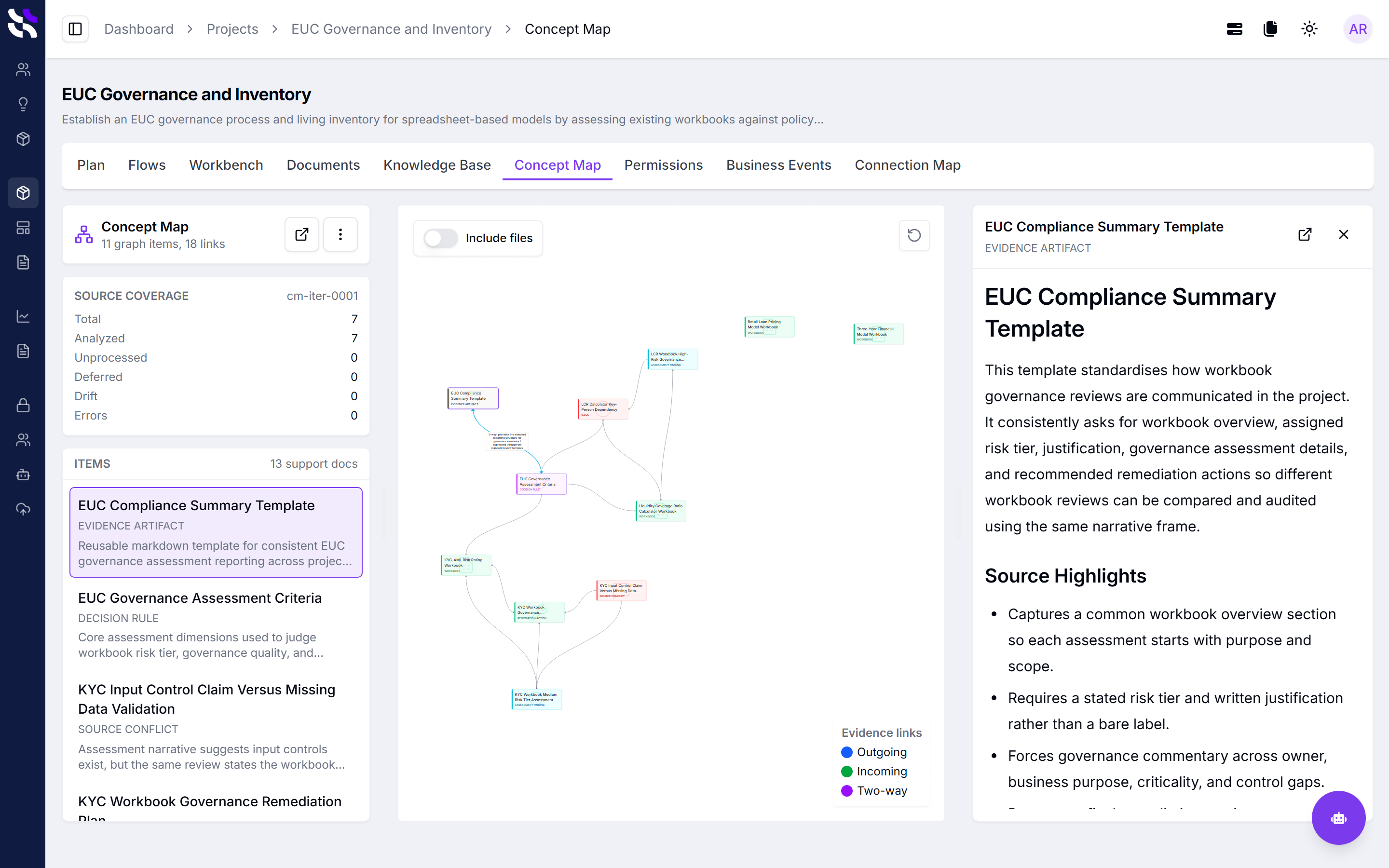
Coherent Insights treats the estate as the unit of analysis: discovering files across drives and SharePoint, clustering them into model families by what they compute rather than what they are named, reconstructing lineage and formula drift across versions, and ranking where risk concentrates. In one partner-led engagement, roughly 800 workbooks were tagged and assessed in six weeks against an original three-month manual timeline.
The distinction in one line: Copilot helps a person interrogate a file. Insights lets an organization interrogate an estate, with answers that accumulate instead of evaporating when the chat ends.
Which leaves the question every pilot eventually meets: even a good answer has to be provable.
Copilot gives you a draft; Coherent gives you evidence you can defend
The third wall is the one that stops pilots from becoming operations, and it has nothing to do with whether the answer looked right. The outcome here is institutional: satisfy the AI steering committee, clear model-risk sign-off, move a calculation into production, walk into the audit with a record instead of a reconstruction.
When buyers tell us where AI-assisted analysis has to clear the bar, the requirements are consistent across insurance, banking, and advisory:
-
Evidence: output grounded in the underlying workbook, policy, or source, with citations.
-
Reproducibility: the same input yielding the same conclusion tomorrow. One AI leader's acceptance test: run at least two tools against each other and pick the more stable one.
-
Human accountability: a named reviewer approving before anything reaches production.
-
An audit trail: versions, submissions, and sign-offs retained as the work happens.
Plausible is not a category on that list, and chat output arrives without any of it attached. Coherent builds those properties into the workflow: assessments carry evidence and reasoning back to the workbook, review and approval gates sit between AI output and anything consequential, and every activity lands in an audit-ready history.
For the deepest version of the question, the calculations themselves, Coherent Spark runs governed workbook logic as a deterministic calculation engine: same inputs, same outputs, regression-testable against known results. That is how one insurer publicly described validating AI-extracted data against sixteen months of actuarial calculations rather than taking plausible output on faith.
What about Copilot Studio?
Some teams take the question further. Copilot Studio lets power users build and deploy their own agents with low code, so why not build a spreadsheet review agent in-house? Studio is a capable platform for building and governing agents, and in most target architectures we would expect it to stay. It changes who assembles the agent, not where the trustworthy calculation comes from.
But the agent still runs on the same underlying model, so it reads a workbook as content to interpret rather than a calculation structure to decompose, and it tests how the agent behaves rather than proving the spreadsheet math underneath is correct and reproducible. Building those properties yourself means rebuilding validated spreadsheet logic as flows or connectors, then standing up the testing, versioning, and approval around it, work you would own and maintain for calculation integrity and estate discovery Coherent already provides out-of-the-box.
Where Copilot Studio fits is the agent itself. It can call Spark-governed models through the Coherent MCP server, the same division of labor described below. The agent interprets intent and runs the conversation. The governed model returns a calculated answer with its inputs, version, and traceability.
Copilot helps the person work; Coherent makes the business logic trustworthy and executable
The organizations furthest along are not choosing. They are dividing the labor across Copilot and Coherent, and the division is consistent:
-
An approved enterprise assistant helps actuaries write the orchestration code, while the governed calculations execute through Spark APIs with full traceability.
-
Copilot or Claude assembles the client presentation, while every number on the slide comes from a Spark model run, not from the assistant's recollection.
-
Analysts explore freely in their chat tool of choice, while a test bench in Coherent compares that output against known-correct governed calculations before anything ships.
The connective tissue is increasingly direct: Coherent provides an MCP server that lets AI agents call Spark-governed models as tools. The agent interprets the request; the governed model calculates the answer. Your assistant gets smarter about your business without your business logic ever depending on the assistant's arithmetic.
Coherent vs. Copilot: Which should you use?
Choose Copilot when the job is personal productivity:
-
Single, familiar files and bounded questions
-
Drafting, formula explanation, coding assistance
-
Output that feeds a human decision, with a human checking it
-
Nobody downstream will ask you to prove the answer
Choose Coherent when the job is the logic itself:
-
Answers that vary between runs are unacceptable
-
The question is about a population of files, not one of them
-
A reviewer, auditor, regulator, or AI committee wants evidence, not output
-
Calculations feed systems and decisions, not just conversations
The best answer for most enterprises is to combine the two, so your teams keep the assistant they already work in while the spreadsheet logic underneath comes from governed, regression-tested calculations. The analysis gets faster, the numbers still hold up when the auditor or the board asks how you know, and audit season stops being an archaeology dig.
If you're already on Copilot and wondering how to layer in Coherent, start from the estate side: see the Coherent platform in action against your own spreadsheets. And if you're already running Coherent Spark, the fastest win is connecting your AI tools to your governed models through the Coherent MCP server, so your assistant starts calling your calculations instead of estimating them.