
Everywhere you turn, AI is reshaping how work gets done—and the actuarial profession is no exception. But here's the question keeping many actuaries up at night:
“What role will AI play in our work—and how much of the craft will it transform?”
That's exactly what we explored in our recent webinar, "Redefining the Actuary's Edge in the Age of AI," featuring expert perspectives from EY, Oliver Wyman, and Coherent.

If you missed the live conversation, consider this your companion piece: a curated overview of the themes, quotes, and stories that defined the discussion—and a primer before you watch the full webinar on demand.
You'll discover where the real bottlenecks lie (spoiler: it's not the math), which cultural factors separate fast adapters from slow ones, and practical steps you can take this week to start experimenting with AI tools.
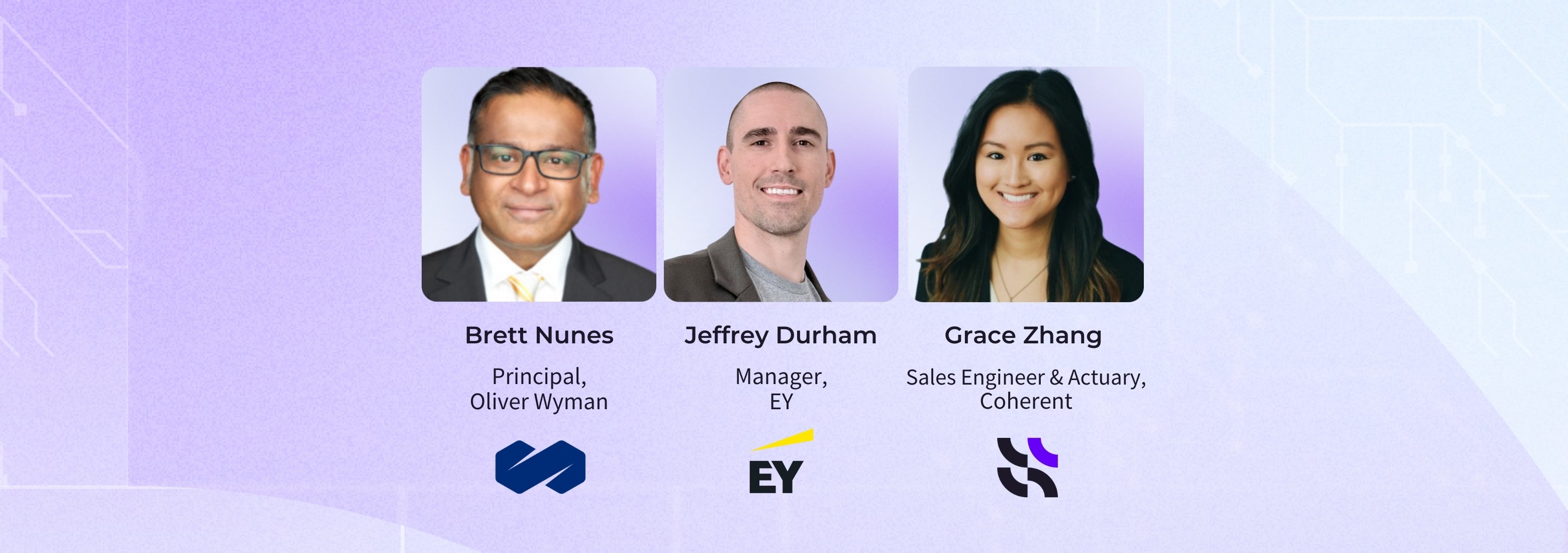
Featuring Expert Insights From:
Jeffrey Durham, FCAS
Manager, Pricing and Rating Center of Excellence, EY
Helping actuaries bridge the gap between actuarial work and enterprise IT systems
Brett Nunes
Senior Principal, Oliver Wyman Actuarial
Specializing in pricing, product design, and responsible AI frameworks for insurers
Grace Zhang, ACAS
Sales Engineer, Coherent
Working directly with actuarial teams to modernize workflows and overcome technical roadblocks
The Real Challenge: It's Not the Math, It's the Plumbing
One of the clearest themes from the panel? Actuaries aren't struggling with complex calculations-they're drowning in the mechanics around the math.
"The math is never usually the problem. It's everything around the math — pulling data, cleaning it, reconciliation, testing, versioning. That's where people get stuck."
Grace shared a powerful example: a client whose Excel model took minutes per policy and needed to run thousands of times. By moving the model to Coherent Spark and using AI coding tools to automate the workflow, they achieved millisecond runtimes with full governance.
The breakthrough? The math didn't change. The plumbing did.
This is where modern tools and AI shine-not replacing actuarial judgment, but removing the friction that prevents actuaries from doing their best work.
Actuaries as the 'Amish' of Tech: Brilliant Builders, But Not Tech People
Jeffrey Durham, Fellow of the Casualty Actuarial Society and leader of EY's Pricing and Rating Center of Excellence, offered an analogy that resonated throughout the discussion:
"Actuaries are like the Amish. We're handy—we can build a barn in a day or a pricing analysis in Excel—but we don't really know much about how the big city folk in IT work and how they think."
The gap between actuarial work and enterprise IT systems has been a persistent challenge.
Actuaries want control over their rates and data. They want to build analyses, test scenarios, and push changes to production—all without creating requirements documents for IT teams to implement weeks later.
Tools that bridge this gap are becoming essential. When actuaries own their logic and can deploy it directly into production systems through APIs, they can finally spend more time on insights and less time on coordination.
AI Won't Replace Actuaries-But It Will Change What They Do
Perhaps the most important takeaway? AI isn't here to replace actuaries. It's here to give them back what matters most: time to think.
Jeffrey noted that when he started his career, the emphasis was on becoming a better data scientist-learning R, Python, and machine learning. But AI is rapidly closing that skills gap:
"You'll be able to just tell a system what you want to program and it'll do that. You'll tell it what model you want to build and it'll build the model for you. But that doesn't replace the skill set of the actuary."
The actuarial skills that matter-understanding risk, applying judgment, interpreting credibility, telling the business story-remain uniquely human. AI can generate options, but it can't tell you which one is right for your book, your risk appetite, or your loss ratio targets.
As Grace put it:
"AI should be guiding us by expanding our options, but we're still the ones deciding what's reasonable and what's the best fit."
Building Responsible AI: Six Pillars for Success
With great power comes great responsibility. Brett Nunes, Senior Principal at Oliver Wyman, outlined a practical framework for how insurers should approach AI governance:
The Six Pillars of Responsible AI
- Accountability: Cross-functional teams with clear decision-making authority
- Transparency: Understanding how models work and arrive at conclusions
- Privacy: Responsible collection and use of sensitive data
- Fairness & Bias: Managing inherent biases and reducing them over time
- Security & Safety: Aligning with vendors and meeting internal standards
- Third-Party Risk: Understanding model evolution and operational impact
Brett emphasized that organizations should start small. Begin with pilots, learn from early experiments, and scale governance appropriately based on organizational size and readiness.
What Separates Fast Adapters from Slow Ones?
Not all teams adapt to AI at the same pace. According to Grace, the differentiator isn't technical sophistication-it's culture.
"The teams who adapt quickly aren't the ones with the most advanced tooling. They're the ones who treat experimentation as normal and feel confident to experiment safely."
Grace drew a parallel to GLMs: when generalized linear models became widely used, the math wasn't the blocker-actuaries already understood the statistics from exams. The teams that moved fastest figured out how to operationalize GLMs: how to validate them, document them, explain them to regulators, and embed them in rating plans.
AI is no different. The advantage belongs to teams that build processes, establish guardrails, automate what should be automated, and trust their systems enough to focus on insights instead of mechanics.
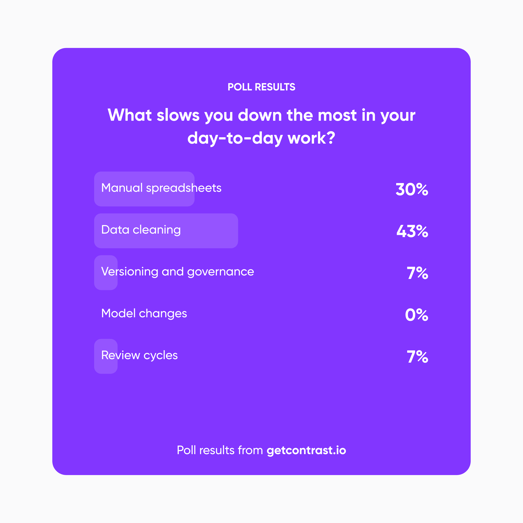
A live poll during the webinar confirmed exactly what actuaries experience day to day:
Data cleaning is the #1 workflow challenge slowing teams down.
Looking Ahead: Preparing for the Next 5 Years
What should actuaries be doing today to prepare for tomorrow?
The panel highlighted two critical foundations:
1. Data readiness
Not perfect data -- no one has that. But consistent definitions, cleaner inputs, and structured processes. Teams that invest in data foundations now will move exponentially faster when new AI capabilities emerge.
2. Safe experimentation and governance
Guardrails that enable rather than restrict. When actuaries can try new tools without worrying about breaking production systems, innovation accelerates. The goal isn't control-it's confidence.
Jeffrey painted an optimistic picture of what's possible:
"I think it's fully possible for any organization to go from where they are right now to in 5 years being fully integrated pricing and rating owned by the actuaries and plugged into your policy admin system."
When actuaries reclaim that time currently lost to data wrangling and coordination, they'll unlock opportunities to innovate that many teams haven’t had the capacity to explore.
Takeaways You Can Apply Now
Based on the panel discussion, here are concrete actions you can take today:
- Start experimenting with AI tools in your daily work. Don't wait for a massive initiative. Ask yourself: "How can AI help me solve this specific problem today?"
- Focus on translation, not mastery. You don't need to understand every line of code. You need to know how to interpret outputs and translate them into business decisions.
- Build cross-functional teams. Include actuaries, data scientists, IT, legal, and compliance in AI conversations from the beginning.
- Invest in data infrastructure. Even small improvements in data consistency and accessibility compound over time.
- Create guardrails that enable experimentation. Safe sandboxes allow actuaries to test AI tools without production risks.
Most importantly: remember that AI is a tool, not a threat. The actuaries who thrive won't be the ones who resist change or try to master every technical detail. They'll be the ones who stay curious, experiment thoughtfully, and double down on uniquely human skills like judgment, interpretation, and storytelling.
Watch the Full Webinar
This recap only scratches the surface of a rich 45-minute conversation. The full webinar includes:
- Live poll results showing what's slowing down actuaries today
- Audience Q&A with the expert panel
- Specific tool recommendations
- Detailed discussion on bridging the actuarial-IT gap
If you’d like the full conversation in the panelists’ own words, you can watch the webinar on-demand.
Learn How Coherent Supports Actuaries
Much of what the panel described—the friction around models, the gap between actuarial logic and IT systems, the desire for safe experimentation, and the need for speed—mirrors what actuarial teams bring to Coherent every day.
Coherent Spark helps actuaries modernize their workflows by transforming spreadsheet logic into governed, cloud-native APIs that actuaries can maintain and control.
The math stays the same. The process moves faster—without adding risk or complexity.