
.png?width=1034&height=550&name=Set%20PNG%20to%202.5s%20Mark%20(2).png)
Here's the short version:
- The Hidden Logic problem: The rules, calculations, and judgment that run an enterprise mostly live in ungoverned spreadsheets, not in systems of record, and AI exposes that logic the moment it tries to reason about the business.
- What to do about it: Surface the logic so it can be seen, govern it against your own policies and risk tolerances, then operationalize it so any system can call it.
- Why it matters: Governed, callable logic becomes a single source of truth that AI can use and defend. That is the difference between AI that processes your data and AI that can reason about your business.
Every company has a special sauce. The rules, calculations, and judgment calls that define how it actually works, and that separate it from everyone else in the market. That logic rarely lives in a documented enterprise system. It lives in spreadsheets, on individual desktops, in the files people open to do their jobs.
AI has not changed that. It has made it impossible to ignore. The moment you ask an AI system to reason about your business, you run straight into the logic it cannot see.
AI exposes the problem
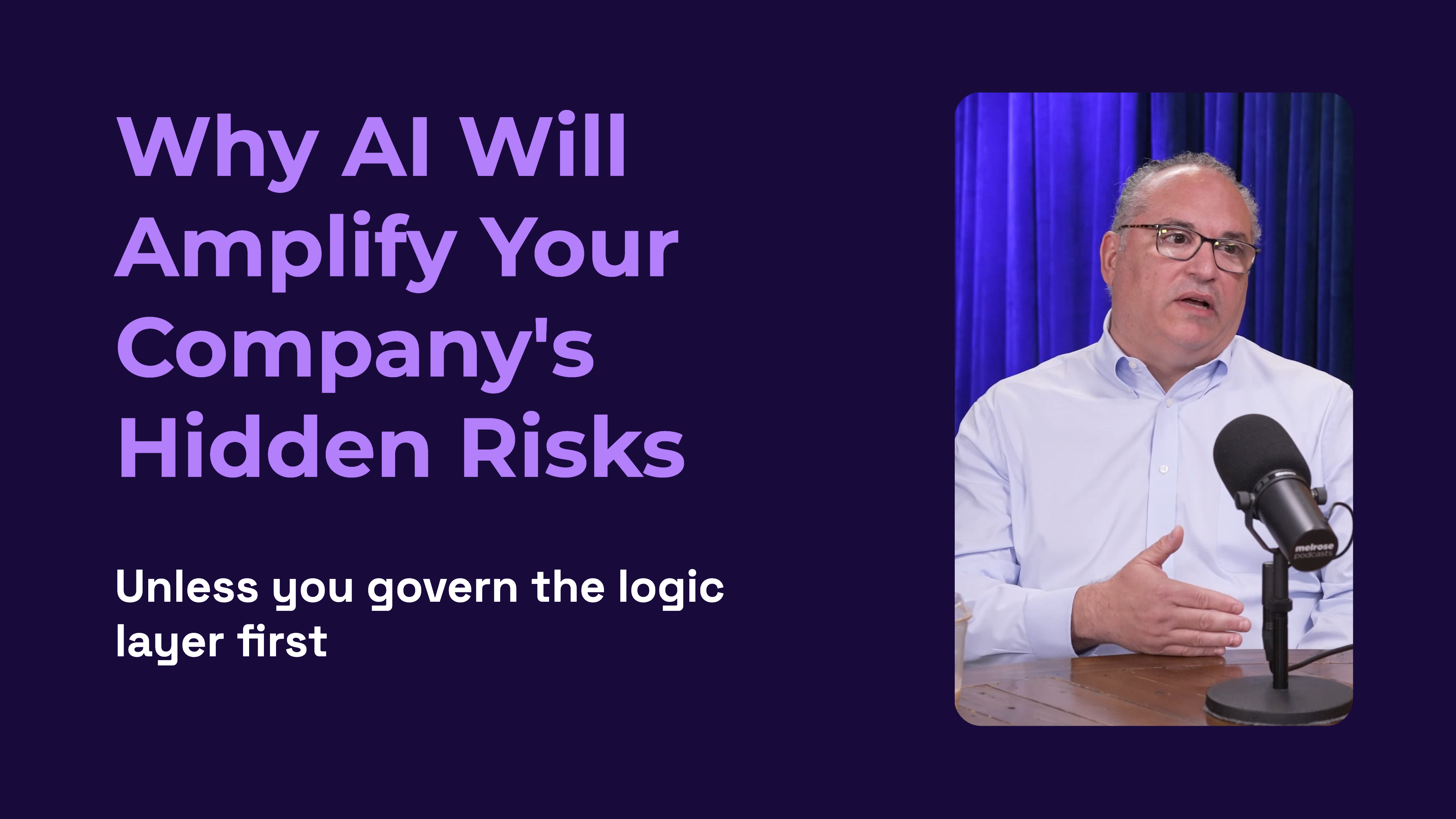
As Barbarino frames it, the new AI era exposes a problem in the logic layer: the rules, the behavior, and the calculations that define what a company actually is. That logic has a home, and it is not the enterprise stack.
"This logic is contained in spreadsheets on people's desktops. That is where all of this IP has been held, and up until now it has not had the ability to be unlocked."
This is the Hidden Logic problem, and it is worth being precise about it. The logic is not hidden because anyone chose to hide it. It is hidden because the enterprise never built the layer to surface it. The people who built it are not the problem. They are the reason the business works at all.
Unearthing the special sauce
Surfacing the logic is step one. The point of seeing it is what becomes possible next.
"You take the special sauce that defines what the company is, and you unearth it so it can be known, and then governed."
Once the logic is visible, an institution can segment the risk it carries and apply its own policies and tolerances to it. That distinction matters more than it first appears.
"Now it is not some arbitrary AI engine of the moment telling them what should be done. They are using their own policies and their own guidance to take action where it was not knowable before."
Governance, in other words, runs on the institution's judgment, not on a model's opinion.
Making it executable
The final move is the one most organizations never reach. Visible logic that stays trapped in a file is still trapped. The value comes when that logic becomes something systems can call.
"If I have logic that governs my business and I want other systems to call it as a single source of truth, I have the ability to call the logic layer and execute the workflow."
Codified, versioned, and callable, the same logic that defined the business quietly for years can now run the business openly, including the AI that depends on it.
Why it matters
This is the throughline of everything Coherent builds. See the logic. Govern the logic. Operationalize the logic. It is the difference between AI that processes your data and AI that can actually reason about your business and defend the answer.
Your spreadsheet estate is your AI intelligence estate. The work starts with making it visible and AI-callable.
.png?width=352&name=65730bbb510debc4c8c4184c_SC%20-%20Article%20Banner%20(EN).png)